A family meeting about college can easily become an audit of the student’s entire life. One question about an upcoming expense turns into questions about classes, friendships, sleep, work, and future plans. The student leaves exhausted, while supporters still feel they lack a clear answer. A focused meeting needs a smaller job.
The twenty-minute format below is an editorial suggestion, not a University requirement. Adapt the length to the people involved. The University of Utah’s public family resources can help supporters find official information before meeting. For individual records, the Registrar recommends direct student contact. A household discussion should prepare useful action, not imitate an institutional review.
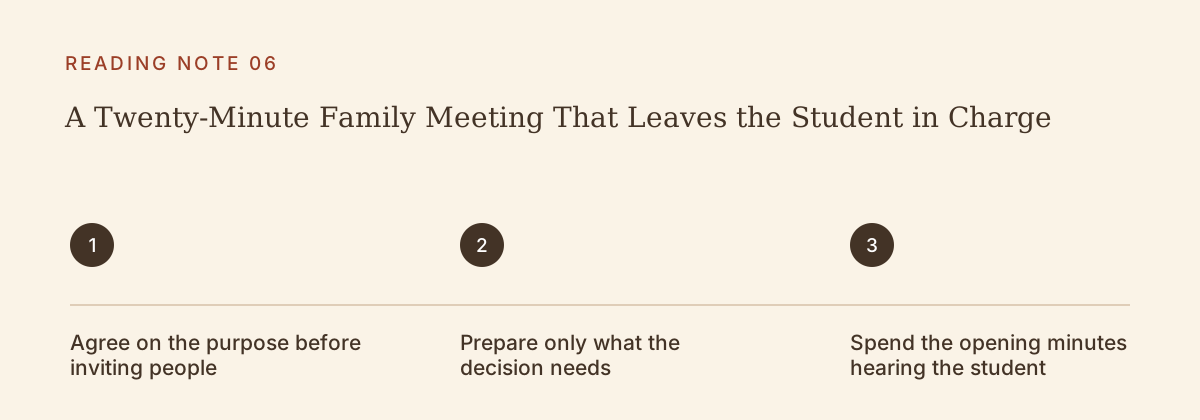
Agree on the purpose before inviting people
Choose one sentence that describes the result you need: “Agree on this month’s contribution,” “Prepare two questions for an office,” or “Decide what help would be useful during a busy week.” If the purpose contains several unrelated decisions, split the conversation. A broad agenda rewards the person who talks most rather than the issue that matters most.
Ask the student who should attend. A person who contributes money does not automatically need to hear every personal concern, and a supportive relative does not need an invitation simply because they are curious. Smaller meetings can make it easier for the student to speak honestly and for everyone to stay on topic.
If participants disagree about the audience, resolve that before opening documents or beginning a call. Do not surprise the student by putting another relative on speakerphone. A meeting should have a known audience, especially when academic or financial details may come up.
Prepare only what the decision needs
Ask each person to bring one relevant question or fact. Supporters can read public official information in advance instead of using the student’s time to explain basic terminology. The student can choose whether to summarize a record or show a relevant portion. Complete account screenshots should not be a routine admission ticket to the conversation.
Choose a private setting with reasonable attention. If people are joining remotely, ask whether anyone else can hear. Avoid recording by default. Written notes should capture decisions and actions, not reproduce the student’s personal history. If a participant wants a recording or detailed notes, discuss that openly beforehand.
Make the agenda visible in a simple form. It can be three lines on paper: what we need to decide, what we need to clarify, and who will do what next. The agenda is a tool for keeping the meeting small, not another task the student must perfect.
Spend the opening minutes hearing the student
Invite the student to describe the situation first without interruption. Ask what they want from the meeting and what they have already tried. A supporter can take brief notes on questions to ask later instead of interrupting each unfamiliar detail. This helps distinguish missing information from disagreement.
Then reflect the issue back in one sentence. If the student corrects that summary, accept the correction before moving on. A meeting about the wrong problem can be efficient and still be useless. The opening is successful when everyone can describe the same practical question.
This is also a good moment to remove topics that do not belong. If a new concern is important but unrelated, agree to revisit it separately. Do not use a “parking lot” as a way to avoid urgent issues; use it to keep ordinary unrelated subjects from taking over the current decision.
Use the middle for one decision or one question
Discuss the information needed for the stated purpose. Label assumptions as assumptions. If a fact needs official confirmation, decide how to obtain it instead of debating which person’s memory is more convincing. A family meeting cannot settle University policy by majority vote.
Where there is a real choice, let each person state their relevant preference or limit. Keep those statements concrete. “I can drive on Thursday” helps planning. “You never plan ahead” does not. Ask what would make an option workable rather than treating the first obstacle as proof that the student’s idea is unreasonable.
If the group cannot decide yet, identify the missing fact and stop there. A useful meeting may end with a well-formed question rather than a final answer. That is preferable to forcing certainty because the allotted time is nearly over.
End with ownership, not a lecture
Use the final minutes to confirm the next action, its owner, and when the group will revisit it. The owner should agree, not simply be assigned work while everyone else watches. Ask whether a reminder would help and how it should be sent.
Read the action summary aloud. For example: “You will ask the official office about the unresolved issue; I will confirm what I can contribute; we will compare those answers on Sunday.” This is a fictional household example, not a University timeline. Use timing that fits the actual situation and official requirements.
Do not add several new expectations as people are leaving. A closing lecture can undo the trust built during the meeting and leave participants unsure whether the written plan is still the plan. If another issue needs discussion, schedule it honestly as another conversation.
Adjust the format after trying it
Ask one question afterward: “Did this make the next step easier?” If the answer is no, identify why. Perhaps too many people attended, the topic was too broad, or the student needed listening rather than a planning session. Change the format instead of insisting that a formal meeting is always the best support.
A successful routine can become lighter over time. Some families need a short call, others an occasional text exchange. The point is not to maintain a twenty-minute ritual indefinitely. It is to create a predictable place where the student can ask for help, supporters can state limits, and practical decisions can be made without unnecessary access or pressure.
Official source: University of Utah: Family Checklist