Searching for Utah CIS as a parent or partner often begins with an ordinary concern: you want to help, but you cannot see the information that would make helping easy. Perhaps you contribute to tuition, coordinate travel, or want to understand why the student sounds overwhelmed. The useful starting point is to decide what help is needed before deciding what access to request.
CIS means Campus Information Services at the University of Utah. This independent guide is for supporters, not a substitute student portal. Family Support Almanac is unaffiliated with the University and cannot inspect accounts, accept tuition, change permissions, or resolve a student case. Our role is to explain choices and offer conversation tools that families can adapt privately.
The University’s Family Checklist mentions both a FERPA PIN and becoming an Authorized Payer. Those references are useful prompts to discuss separate needs. They are not an invitation to share the student’s sign-in. The University’s security guidance prohibits sharing assigned accounts. A support arrangement should work even when the student keeps their password and authentication device entirely private.
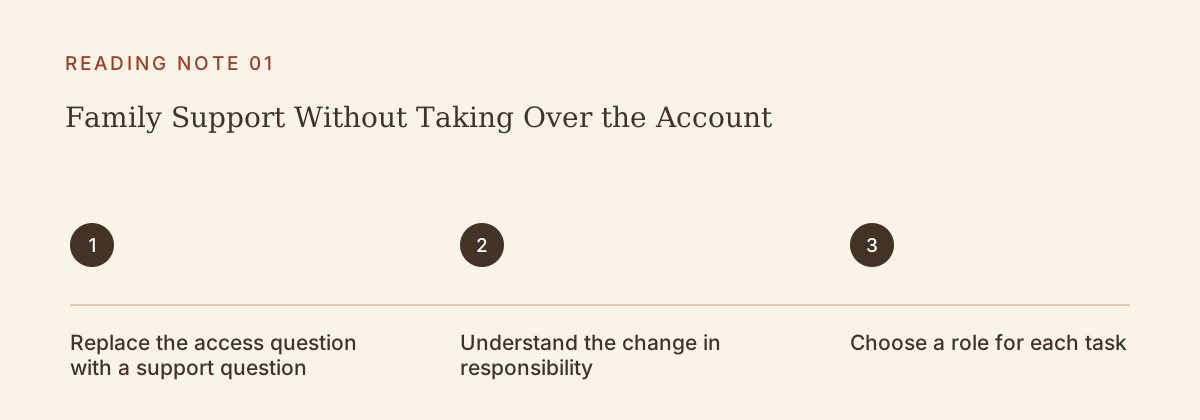
Replace the access question with a support question
“What do you need help accomplishing?” usually produces a better answer than “Can I get into your account?” A student may need someone to read a confusing paragraph, rehearse a phone call, arrange a ride, or discuss a contribution. None of those tasks automatically requires complete access to academic and financial information. The practical help can be much narrower than the surrounding worry.
Try naming a concrete outcome. Instead of “I need to know everything is fine,” say, “I need to know whether our agreed contribution is enough for the payment we are discussing.” Instead of requesting continuous access to grades, ask whether the student wants help preparing for an advising conversation. The narrower question respects boundaries and gives the supporter something achievable to do.
Some students want extensive involvement; others want occasional help. Neither arrangement should be presumed from age, distance from home, or who pays. Ask what involvement feels useful now. A familiar family routine from high school may no longer fit a student living independently, supporting children, working irregular shifts, or sharing responsibilities with a partner.
Understand the change in responsibility
The U.S. Department of Education explains that FERPA rights transfer to the student at age 18 or when the student attends a postsecondary institution at any age. Families should not assume that a parent-school communication pattern continues unchanged in college. Individual disclosure questions belong with the University, including questions about exceptions and unusual legal circumstances.
For daily family life, the adjustment is broader than a legal rule. The student becomes the person who holds the context: which question matters, what has already been tried, and what outcome they want. Support works better when that context comes first. An adult who immediately calls an office may unintentionally ask an outdated question or create a second conversation the student must reconcile.
A useful opening is, “Tell me what you have already done, and what would help next.” This acknowledges effort without requiring the student to prove that they deserve assistance. If they have done nothing because the problem feels intimidating, help define the smallest next action rather than taking ownership of the entire matter.
Choose a role for each task
Think in roles rather than permanent labels such as “the organized parent” or “the responsible partner.” One person can be a listener today and a contributor tomorrow. A role should describe the current job, its limits, and when it ends. That makes it easier to ask for help without surrendering control of unrelated decisions.
- Listener: hears the student’s concern without immediately solving it.
- Research partner: finds public official information and checks which office owns a question.
- Preparation partner: helps turn a confusing situation into a short, accurate inquiry.
- Financial contributor: states what they can contribute and coordinates an agreed payment.
- Authorized participant: joins a specific official conversation under the University’s applicable consent and verification process.
For example, a student might ask a sibling to compare public transportation information while asking a parent to help discuss costs. Neither helper needs the other person’s entire conversation. Several adults can support one student without creating a shared dossier or a group chat containing every detail of the student’s life.
Agree on what information is actually needed
A family can coordinate using a small amount of information: the task, the decision needed, the person responsible, and a time to revisit it. An agreement might say, “We will talk about the next planned contribution on Sunday; you will bring the current amount you want us to discuss.” That is different from requiring a weekly screenshot of every account page.
When a document is genuinely useful, ask which portion is relevant and whether a verbal summary will do. Let the student choose what to show. Avoid collecting identification numbers, consent codes, full bank details, or unrelated records in a household spreadsheet. A convenient shared folder can outlive the purpose that originally justified putting information there.
Consider the audience as well as the content. A student may be comfortable talking with one parent but not a family group. A partner may contribute money without wanting other relatives to know the amount. Clarify who can hear the discussion, whether notes will be kept, and whether anyone may forward what is shared. Familiarity does not eliminate the need to ask.
Make financial boundaries explicit
Financial help becomes more dependable when contributors state their limits before a crisis. Say what you can commit, when the money can be available, and whether the arrangement needs another conversation. Avoid language such as “We will handle it” if the real offer is a fixed amount or help with one expense. Vague generosity can create a planning gap even when everyone acts in good faith.
Separate the contribution from the authority to choose. Paying toward education does not automatically settle which major, course, or living arrangement is best. A contributor can explain their own budget limits without presenting access to every student record as the only way to discuss affordability. Where expectations differ, name the disagreement early rather than revealing conditions after the student has relied on an offer.
If more than one person contributes, choose one coordinator for the specific payment discussion. Coordination does not mean that person receives everyone’s financial details. It means the group avoids duplicate payments, contradictory promises, and assumptions about what another person will cover. Record only what the agreed task requires.
Let the student lead official conversations
A supporter can help prepare three sentences: what the student is trying to do, what they have already checked, and what remains unclear. Practice reading those sentences aloud. This small rehearsal often helps more than a long message written in an adult’s professional voice that the student would never naturally use.
If the student wants someone present, agree beforehand on the helper’s role. The helper might take notes, ask one clarification, or help remember a question. Let the student introduce the issue and respond first. Participation should follow the office’s current procedures; a family’s private agreement does not determine what staff can discuss.
After the conversation, ask the student to explain the next step in their own words. Do not treat every staff suggestion as a completed action or every pending review as an approval. The most useful follow-up is often logistical: “Do you need time, a quiet place, or help finding the document they requested?”
Plan for missed messages without creating surveillance
Agree on a reasonable check-in pattern that fits the student’s life. A person working evenings may not answer a morning text promptly. A student in a demanding class may need a day without routine reminders. Decide which channel is easiest, what counts as a time-sensitive household question, and when a follow-up is appropriate.
Avoid turning every unanswered message into a new attempt through another platform. Several relatives contacting the student at once can make a small delay feel like a confrontation. A designated family contact can reduce noise when the student wants that arrangement. Make clear that ordinary coordination is different from a genuine immediate safety concern requiring appropriate local help.
Revisit the agreement when circumstances change
A useful support agreement is a conversation, not a permanent family contract. Review it after a move, a changed budget, a new job, or a shift in the student’s preferences. Ask which help was valuable, which felt intrusive, and which responsibility the student now wants to handle independently. Reducing involvement can be a sign that the arrangement worked.
Imagine a fictional student, Elise, who initially wants a parent beside her during administrative calls. After several successful conversations, she prefers to call alone and send a short update afterward. The family can preserve financial coordination while ending the routine call attendance. They do not need to keep an old level of involvement simply because it was once helpful.
Another fictional student, Marcus, asks his partner for more help during an unusually busy month. They agree that the partner will gather public information and help prepare questions, while Marcus makes decisions and handles his account. Increased support and personal control can coexist when the roles are clear.
A useful first conversation
Begin with one issue rather than the entire semester. Ask what the student wants help with, state any practical limits on your offer, and agree on one next step. End by confirming who will act and when you will reconnect. You can leave unrelated subjects for another day.
A successful conversation does not end with the supporter knowing everything. It ends with the student having useful help and both people understanding their responsibilities. That is the foundation of dependable family support around Utah CIS: enough information for the task, an official route for institutional questions, and room for the student to remain the person directing their own education.
Official source: University of Utah: Family Checklist
Official source: U.S. Department of Education: Who is an eligible student?
Official source: Information Security Office: Cybersecurity basics