A student says they are thinking about changing direction. The supporter hears risk: lost time, extra cost, disappointment, or a decision made too quickly. It is tempting to respond with a solution before understanding the question. Yet a fast answer can leave the student defending an idea they had only begun to explore.
A better conversation helps the student describe the choice and identify what they need to learn. This article offers a general discussion method, not academic advising or an assessment of a particular student’s options. University of Utah advising and Registrar resources provide the official routes for individual academic questions. Family support can make that conversation easier without replacing it.
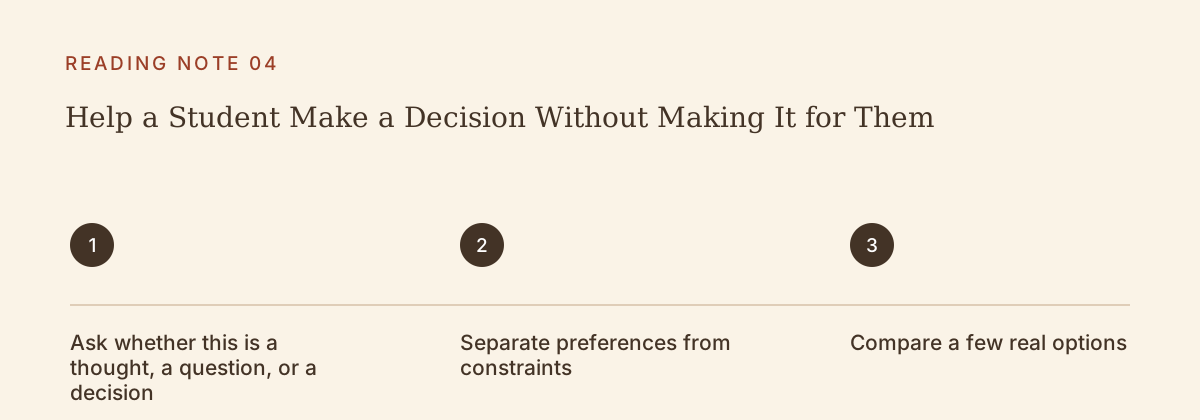
Ask whether this is a thought, a question, or a decision
“I might change my plans” can mean several things. The student may be expressing frustration, gathering information, or announcing a choice already considered carefully. Ask which it is before treating the statement as a request for advice. “Would you like me to listen, help compare options, or help prepare a question?” gives them a concrete choice.
If they want to be heard, do that first. Repeating the concern in plain words can be useful: “The current arrangement is taking more time than you expected.” Avoid adding an interpretation such as “You are giving up” or “You were never interested.” Those judgments turn a practical question into a defense of character.
If they want help deciding, ask what decision is actually available now. Sometimes the immediate task is only to book an advising conversation or learn about a requirement. A family can spend an hour arguing over a final choice that no one is yet prepared to make.
Separate preferences from constraints
Invite the student to name what they want from the next step. They may value time, interest in the subject, flexibility, proximity to family, or a particular kind of work. The supporter may value different things. Write the priorities separately before assuming that everyone is evaluating options by the same standard.
Then identify constraints that need verification. A supposed requirement may be a memory from another program. An assumed cost may be an estimate rather than a current figure. Mark each uncertain statement as a question for the appropriate official source. This keeps a conversation from being driven by confident but untested assumptions.
Supporters should state their own genuine limits plainly. “I cannot increase my contribution beyond what we agreed” is useful information. “This choice is impossible” may overstate what the supporter knows. A financial boundary belongs in the discussion, but it should not be disguised as an academic ruling.
Compare a few real options
Keep the comparison small enough to think about. Ask the student to describe two or three possibilities in their own words, including the option of gathering more information before deciding. For each, ask what appeals to them, what concerns them, and what would need to be true for it to work.
Avoid scoring everything unless the student finds that helpful. A simple list of tradeoffs can expose a meaningful difference without pretending that a personal decision has one mathematically correct answer. Something difficult to measure, such as enthusiasm for the work, can still matter.
Look for assumptions shared by all the options. If every plan depends on an unresolved course question, that question may deserve attention before the family compares anything else. Helping identify the common uncertainty is often more valuable than arguing for a preferred outcome.
Prepare the student’s official question
The University’s advising release guidance addresses third-party participation in individual record discussions. If a supporter joins such a conversation, follow the office’s consent and verification requirements. Do not assume that sitting beside the student or paying expenses settles what staff can discuss.
A supporter can help without attending. Ask the student to write the decision they are considering, the relevant facts they already know, and the questions that would change their choice. Encourage them to use their own language. The goal is a conversation they can lead, not a polished script they cannot comfortably explain.
Afterward, distinguish information from recommendation and recommendation from decision. An advisor’s explanation of an option does not mean the student has selected it. Ask what the student understood, which uncertainty was resolved, and whether another question remains. Let the student decide how much of the conversation to share.
A fictional disagreement handled differently
In an invented example, Jordan wants to explore a different academic direction. His mother worries about affordability and immediately argues against changing anything. Jordan becomes defensive, and neither person learns whether the proposed change would affect the family’s actual contribution.
They restart by separating the questions. Jordan explains what he finds unsatisfying and what he wants to investigate. His mother states her contribution limit. They agree that Jordan will ask an advisor about the options and check relevant official financial information before they discuss a revised household plan.
The restart does not guarantee agreement. It produces a better disagreement: each person knows which values, limits, and facts are at issue. They can discuss the actual choice instead of reacting to an imagined version of it.
Leave room for ownership and revision
End with an action the student can own. It might be sending a question, reading a public program page, or scheduling a conversation. Ask whether they want a reminder and, if so, when. Repeated unsolicited reminders can turn a chosen next step into a test of obedience.
When the student returns with new information, let the comparison change. Do not require them to defend an earlier tentative idea just because it was discussed enthusiastically. Learning something that changes a plan is useful progress. Your contribution is the quality of the conversation, not whether the final decision matches your first preference.
Official source: Undergraduate Academic Advising: Release of Information
Official source: Registrar: Help